a mushtaq

  • Subscribe to our RSS feed.
  • Twitter
  • StumbleUpon
  • Reddit
  • Facebook
  • Digg
Showing posts with label Context of practice. Show all posts

Tuesday, 28 February 2012

PREP TASK//PUBLICATION

Posted on 13:39 by cena
As a starting point to beginning to think about the publication, we were given a task to go through our design context blog and identify 10 significant pieces of source material or starting points that could be developed into a publication which has a personal value and interested in it.

Here are the 10 I've identified

1: Russian Revolution

I found the Russian revolution really interesting, especially the art and design and moviemaking that went into it. Such as the movies by Eisenstein. There's obviously volumes of research out there that I can look into. I wrote an essay on the subject so I think I have a good basis. Visually, Russia had a very distinct style post civil war.


2. Hitchcock

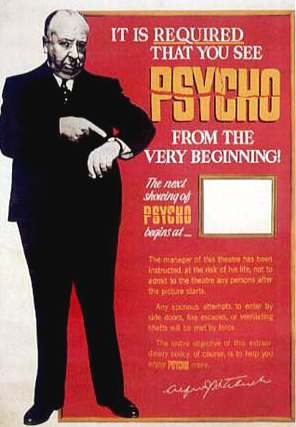
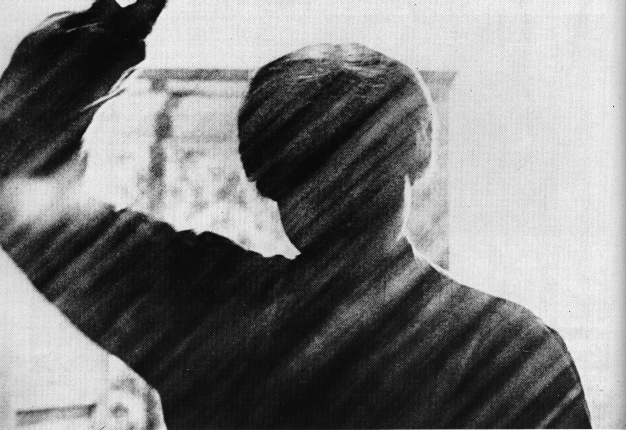
I found the Hitchock lecture fascinating and find the man himself very inspiring. I think it would translate to a publication perfectly. It makes sense in my head, especially as Saul Bass is synonymous with Hitchock's movies so it'd be fun to somehow mix the both and create a publication giving information on the cutting edge techniques and facts about Hitchcock and his movies in a visual way. Would be fun. Also I could be creative with how the user interacts with the content once I outline the content.


3. Film Auteurs

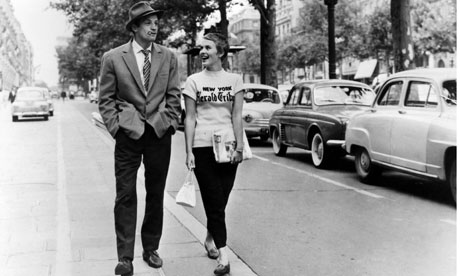
Also found this lecture pretty interesting, think French and European New Wave cinema had a very distinct visual style and it'll be cool to explore.


4. Manifesto's

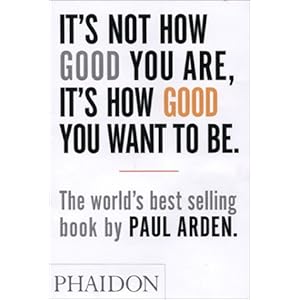
As part of a Jo task we looked into manifestos, and I found them very interesting and inspiring. Maybe I could look into manifestos and create a sort of 'self-help' publication just so that people can pick it up and be inspired and to think of life in a much more positive and better way. It'd be pretty visual though, don't just want massive paragraphs and paragraphs of copy.


5. Graffiti/Street Art

Graffiti and illustration is something I've always really been into, the lecture itself barely delved into graffiti and it'd be interesting for me to personally to delve into it more. Maybe create a factfile showing the beginnings, the rise, the change in graffiti and where it's at now.


6. Accidental inventions

For my 403 Design Skills module a while back I looked into accidental inventions as part of my proverb posters brief and it was really cool. For example popsicles were invented when a guy left his drink with a straw inside it in his garden overnight!


7. Art of manliness/being a gentleman

This was for my collecting brief as part of the 405 Design process module. I find the whole manners/being a gentleman thing really interesting and the whole etiquettes and classical mannerisms that a 'man' does or should do. I think visually it can be really cool. I like all these old retro barbershop logos etc and the use of moustaches etc to promote manliness. I think it could probably be quite humorous and be easy to pick up and read.


8. Constructivism

An art movement that continually inspires me and influences my work. I love Rodchenko's work and love the social and political agenda of the Constructivists. They literally wanted to construct society through design, which I find interesting. Obvious choice is to have a constructivist aesthetic to the publication but I could probably be a bit more less obvious with the interaction and function of the publication.


9. Movie cliches

I looked into Bollywood and Indian Cinema cliches as part of the OUGD405 module and I think looking into overall movie cliches on the whole would be great fun. I'm just really into movies generally, everything about them. Visually it could work well, with each cliche illustrated, or possibly adding some sort of interaction such as pulling tabs, pop-out folds etc.


10. Advertising

The lecture and seminar on advertising was quite interesting. I find the whole corporate and marketing side of advertising quite interesting and the whole subliminal messages and psychology to it. Maybe a factfile, figures, stats etc would be cool. I don't really know how I could make this dynamic and interesting though, as of right now.


As it stands, my favourite and one I have a good feeling about is going ahead with Hitchock. I'm interested to find out more about Hitchcock and I love Saul Bass' work too so researching both would be really enjoyable.


Read More
Posted in Context of practice, OUGD401, Publication | No comments

Monday, 27 February 2012

CREATING A PUBLICATION

Posted on 13:52 by cena
So last week we had a briefing on the second part of the OUGD401, Context of Practice. In essence, we need to collate an area of interest and study from previous lectures/workshops and tasks and create and collate it together into a publication of some sort.

My essay was on the social change in Russia and Germany affecting art and design in their respective countries and how they were both similar but had different legacies, playing close interest to Russian constructivism and modernism in Europe, especially Bauhaus. Initial thoughts of mine were that I'd probably create a publication of some sort giving information on Russia and notable facts and figures in a visual way representative of that time period and style.

We had a lecture in a seminar on the topic and I obviously looked deeper into it and wrote an essay so I know a decent amount on it, so that's a good start.

So visually it would take cues from aesthetics like this...


After further thought, I remember I quite enjoyed the film lecture, I'm really into movies as it is and find Hitchcock a pretty brilliant filmmaker and a pretty inspiring individual. His cutting edge film techniques are really interesting and visually it's perfect for me as Saul Bass is synonymous with Hitchock's movies and aspects of Saul Bass' style is a style that I'm trying to develop myself personally, so visually I think I'd really enjoy this. Also film posters in general, especially ones from the 40s, 50s and 60s are something I never get bored of.

The content of the lecture is here. Obviously I'll need to have a further enquiry into it and find some cool things out.

Visually, initial signs point to adopting a mixture of cues like these...


Read More
Posted in Context of practice, OUGD401 | No comments

Saturday, 11 February 2012

CONTEXT OF PRACTICE// MANIFESTO (3/212)

Posted on 08:20 by cena
This was an interesting session, first we had a go at some automatic writing, something new to me, but a concept I kind of knew existed anyway. It's similar to just letting out what's on your mind and just writing and writing and writing, the stuff that comes out is quite heartfelt and honest and some mad ideas can come out. I won't repeat what I jotted down, it's probably  abit embarassing! But anyway, it was good and I'll definitely keep doing it. I might make a whole book of it, maybe it'll be worth a lot of money one day?

We then, discussed qualities of graphic designers and things we like in life. It was quite a broad and interesting debate, in the end we all kind of find the qualities in life and the qualities personally and professionally that we respect the most.

For example, what I feel strongly about is honesty. Personally and professionally, I think it's usually in everyones best interest to not mess about just tell the truth. People always benefit from it in the long run.

So the task I need to do is to declare 5 points as a designer. I'll do this by looking at and documenting 5 existing manifestos and then produce my own list of declarations.


≤≥≤≥≤≥≤≥≤≥≤≥≤≥≤≥≤≥≤≥≤≥≤≥≤≥≤≥≤≥≤≥≤≥≤≥≤≥≤≥≤≥≤≥


1. The Manifesto Of The Cloud Appreciation Society

WE BELIEVE that clouds are unjustly maligned
and that life would be immeasurably poorer without them.

Cloud Icon
We think that they are Nature’s poetry, 
and the most egalitarian of her displays, since 
everyone can have a fantastic view of them.

Cloud Icon
We pledge to fight ‘blue-sky thinking’ wherever we find it. 
Life would be dull if we had to look up at 
cloudless monotony day after day.

Cloud Icon
We seek to remind people that clouds are expressions of the 
atmosphere’s moods, and can be read like those of 
a person’s countenance.

Cloud Icon
Clouds are so commonplace that their beauty is often overlooked. 
They are for dreamers and their contemplation benefits the soul. 
Indeed, all who consider the shapes they see in them will save 
on psychoanalysis bills.

Cloud Icon
And so we say to all who’ll listen:

Look up, marvel at the ephemeral beauty, and live life with your head in the clouds!


This is pretty far out there as manifestoes go, most of the declarations are encouragements and things such as reminding people about something. 


≤≥≤≥≤≥≤≥≤≥≤≥≤≥≤≥≤≥≤≥≤≥≤≥≤≥≤≥≤≥≤≥≤≥≤≥≤≥≤≥≤≥≤≥


2. Bauhaus Manifesto - Walter Gropius - 1919


Aims of the Bauhaus
The Bauhaus strives to bring together all creative effort into one whole, to reunify all the 
disciplines of practical art-sculpture, painting, handicrafts, and the crafts-as inseparable 
components of a new architecture. The ultimate, if distant, aim of the Bauhaus is the unified 
work of art-the great structure-in which there is no distinction between monumental and 
decorative art.
The Bauhaus wants to educate architects, painters, and sculptors of all levels, according 
to their capabilities, to become competent craftsmen or independent creative artists and to form a 
working community of leading and future artist-craftsmen. These men, of kindred spirit, will 
know how to design buildings harmoniously in their entirety-structure, finishing, ornamentation, 
and furnishing.
Principles of the Bauhaus
Art rises above all methods; in itself it cannot be taught, but the crafts certainly can be. 
Architects, painters, and sculptors are craftsmen in the true sense of the word; hence, a thorough Gropius, 1919 Bauhaus Manifesto
2
training in the crafts, acquired in workshops and in experimental and practical sites, is required 
of all students as the indispensable basis for all artistic production. Our own workshops are to be 
gradually built up, and apprenticeship agreements with outside workshops will be concluded.
The school is the servant of the workshop, and will one day be absorbed in it. Therefore 
there will be no teachers or pupils in the Bauhaus but masters, journeymen, and apprentices.
The manner of teaching arises from the character of the workshop: Organic forms 
developed from manual skills.
Avoidance of all rigidity; priority of creativity; freedom of individuality, but strict study 
discipline.
Master and journeyman examinations, according to the Guild Statutes, held before the 
Council of Masters of the Bauhaus or before outside masters.
Collaboration by the students in the work of the masters. Securing of commissions, also 
for students.
Mutual planning of extensive, Utopian structural designs-public buildings and buildings 
for worship-aimed at the future. Collaboration of all masters and students-architects, painters, 
sculptors-on these designs with the object of gradually achieving a harmony of all the component 
elements and parts that make up architecture.
Constant contact with the leaders of the crafts and industries of the country. Contact with 
public life, with the people, through exhibitions and other activities.
New research into the nature of the exhibitions, to solve the problem of displaying visual 
work and sculpture within the framework of architecture.
Encouragement of friendly relations between masters and students outside of work; 
therefore plays. lectures, poetry, music, costume parties. Establishment of a cheerful ceremonial 
at these gatherings.

--Quite an interesting read, about the aims and principles of Bauhaus design and their views on art and the similarities they describe between an artist and craftsman.


≤≥≤≥≤≥≤≥≤≥≤≥≤≥≤≥≤≥≤≥≤≥≤≥≤≥≤≥≤≥≤≥≤≥≤≥≤≥≤≥≤≥≤≥


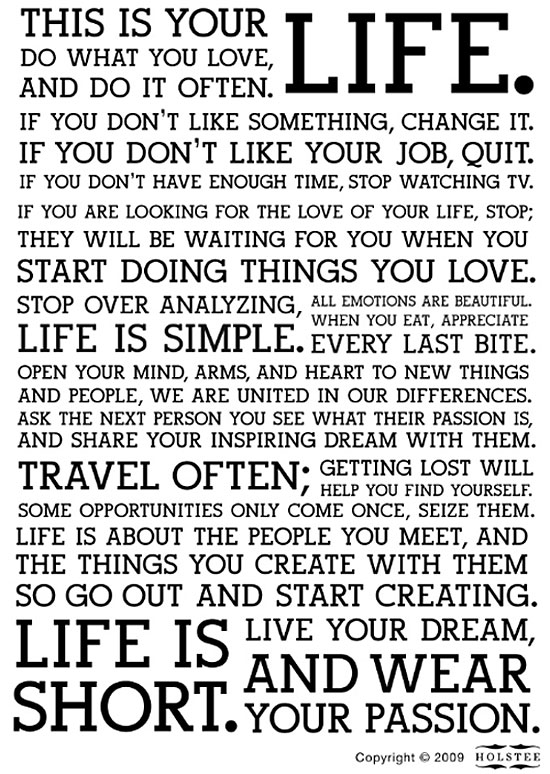
The Holstee Company Manifesto: This Is Your Life


I found the whole thing pretty inspiring, mainly because it's refreshingly honest. 


≤≥≤≥≤≥≤≥≤≥≤≥≤≥≤≥≤≥≤≥≤≥≤≥≤≥≤≥≤≥≤≥≤≥≤≥≤≥≤≥≤≥≤≥


The Designer: John Maeda

1. Reduce: The simplest way to achieve simplicity is through thoughtful reduction.

2. Organize: Organization makes a system of many appear fewer.

3. Time: Savings in time feel like simplicity.

4. Learn. Knowledge makes everything simpler.

5. Differences: Simplicity and complexity need each other.

6. Context: What lies in the periphery of simplicity is definitely not peripheral.

7. Emotion: More emotions are better than less.

8. Trust: In simplicity we trust.

9. Failure: Some things can never be made simple.

10. The One: Simplicity is about subtracting the obvious, and adding the meaningful.


-- Alot of this really rung with me, especially "achieve simplicity by thoughtful reduction". Pretty much sums it up pretty eloquently. 


≤≥≤≥≤≥≤≥≤≥≤≥≤≥≤≥≤≥≤≥≤≥≤≥≤≥≤≥≤≥≤≥≤≥≤≥≤≥≤≥≤≥≤≥


The Company: Apple (2009)

1. We believe that we're on the face of the earth to make great products. 

2. We're constantly focusing on innovating.

3. We believe in the simple, not the complex.

4. We believe we need to own and control the primary technologies behind the products that we make and participate only in markets where we can make a significant contribution.

5. We believe in saying no to thousands of projects so that we can focus on the few that are meaningful to us. 

6.We believe in deep collaboration and cross pollination in order to innovate in a way others cannot.

7. We don't settle for anything other than excellence in any group in the company.

8. We have the self-honesty to admit when we're wrong and the courage to change.


//


Abbas Mushtaq

1. I will enjoy everything I do, If I don't like something, I'll change it. If I start to refer to my art as "work" I'll take a step back and adjust something.

2. I will constantly look to innovate and be different. Once you know the rules you can break them. In all walks of life, if I make anything, I want people to think "I wish I thought of that!"

3. I will always set goals and targets to achieve, whether it's long term plans, plans for the year, plans for the week or even plans for the hour.

4. I will try and learn about anything and everything. I really believe that 'knowledge is power'. You can never know enough and it can only help in any walk of life.

5. I will not be afraid to make mistakes, and will not over analyse any situation, even if it's some design I'm working on. I will just keep doing.

6. I will always be honest, to others and to myself, it's in everyones best interest.

7. I will always be organised, a tidy environment means a tidy mind!

8. I will travel as much as I can, and experience different environments and cultures as much as I can. I will just get out there and do it, whatever it may be.

9. I will be efficient with my time and achieve as much as I can in a day, time is something you can never get back.

10. I will treat others how I would want to be treated, I'll always work hard and be kind to people and I'm confident good things will always happen.


Read More
Posted in Context of practice, OUGD401 | No comments

Sunday, 11 December 2011

JASON MUNN

Posted on 13:00 by cena
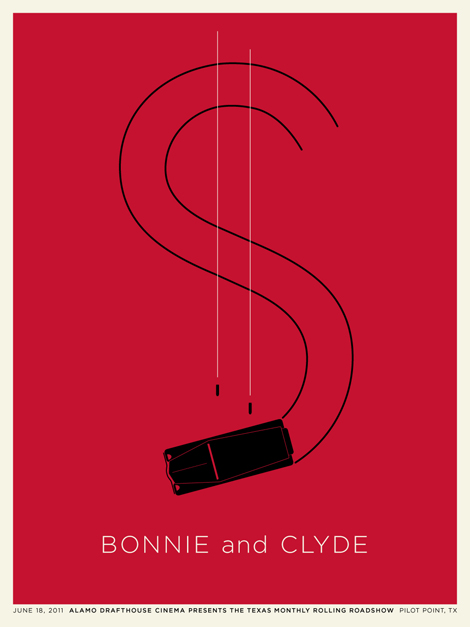
On the designer wall after the speed-designer-dating session I spotted some work I really liked on the wall, turned out it was by Jason Munn. It's quite similar to the designer I shared - Olly Moss. Very idea driven, with kinda 'simple' illustrations, where he simply suggests something through simple shapes but it's all that's needed as it's executed so effectively. I really like the clarity and contrast of the colours. Just generally like this kind of work, it's the kind of direction I want to take with my own work hopefully.


This is really weird, I always draw moons/suns against water! This kind of design is really up my street, I love it.


Read More
Posted in Context of practice, OUGD401 | No comments
Older Posts Home
Subscribe to: Posts (Atom)

Popular Posts

  • TED: Creating Your Logo
    Source:  http://www.ted.com/pages/creating_your_tedx_logo Cool to see what typefaces, spot colours etc organisations use for their logos. //...
  • Graphic Design is Good For Your Health
    Following on from my dissertation and some of the conclusions and aims I applied towards my physical resolution - this article has been real...
  • Morihei Ushiba - The Art of Peace
    I've ordered The Art Of Peace by Morihei Ushiba , it's a philosophy book on Bushido and Martial Arts philisophy by a legendary Aiki...
  • Woodblock printing - Notes/Process/Formats
    My notes: Used to print books before movable type Moku hanga technique differs in that it uses water-based inks Water-based inks provide gre...
  • Foil Blocking & Spot Varnish examples
    I've been looking for examples of different print techniques to see examples of how, for example in this case, foil blocking and spot va...
  • Process : Embossing
    As part of my research into basic definitions of different finishing processes I'm now looking into embossing, how it's done and the...
  • Jessica Svendsen : 100 Days : Müller-Brockmann
    Jessica Svendsen is now a designer at Pentagram, under the tutelage of Michael Beirut. Michael Beirut runs the 100 days workshop where you b...
  • Bushido Quotes
    Here are really interesting Bushido quotes which reflect "The Way Of The Warrior" in martial arts and particularly Samurai culture...
  • Tokyo World Design Conference _ 1960
    Tokyo World Design  Conference                 1960                            As I'm now still keeping a close eye on the development o...
  • List of Illustrations - Practical (Wimbledon) & Pre-Practical Body of Work
    List of Illustrations – Primary Practical (Wimbledon ) Emirates247 {2012) ‘Novak Djokovic Australian Open 2012’ [Image Online] Available at:...

Categories

  • 100 Things
  • Alphabet Soup
  • Collect/Categorise/Communicate
  • Colour Theory
  • Communication Is A Virus
  • Context of practice
  • Cop3
  • Crit Techniques
  • Design For Print
  • Design for Web
  • END OF MODULE EVALUATION
  • Essay notes
  • How To Be A Best Man
  • How To Buy A Diamond Engagement Ring
  • illustrator
  • It's Your Choice
  • Lecture notes
  • Level 05 Essay
  • Level 05 Publication
  • Love/Hate
  • My Red Book
  • OUGD01
  • OUGD401
  • OUGD402
  • OUGD403
  • OUGD404
  • OUGD405
  • OUGD406
  • OUGD501
  • OUGD502
  • OUGD503
  • OUGD504
  • OUGD505
  • OUGD601
  • Personal
  • Photoshop brief
  • Proverb
  • Psychoanalysis
  • Publication
  • Room For Sale Poster
  • Stamp it
  • Study Task 1
  • Study Task 2
  • Study Task 3
  • Study Task 5
  • Task
  • Task 1
  • The Poster Brief
  • THREE
  • Typo-Gateaux
  • Typography
  • What Is A Line

Blog Archive

  • ▼  2014 (21)
    • ▼  March (1)
      • Graphic Design is Good For Your Health
    • ►  January (20)
  • ►  2013 (105)
    • ►  December (8)
    • ►  November (7)
    • ►  October (6)
    • ►  September (30)
    • ►  July (1)
    • ►  June (1)
    • ►  May (13)
    • ►  April (10)
    • ►  March (5)
    • ►  February (20)
    • ►  January (4)
  • ►  2012 (228)
    • ►  December (18)
    • ►  November (41)
    • ►  October (23)
    • ►  September (1)
    • ►  May (38)
    • ►  April (18)
    • ►  March (45)
    • ►  February (23)
    • ►  January (21)
  • ►  2011 (83)
    • ►  December (18)
    • ►  November (37)
    • ►  October (19)
    • ►  September (9)
Powered by Blogger.

About Me

cena
View my complete profile